
On 26 February 2026, IFRA-Nigeria and the Institute of African Studies (IAS) of the University of Ibadan, co-hosted the newest conference in our “Imagine(d) Africa” series. Dr Kudus Adebayo, from the IAS, held a presentation titled “In the Shadows of Global Migration and Deportation: Nigerian men in search of livelihood in China”. Prof. Rasheed Olaniyi, from the Department of History of the University of Ibadan, was his discussant.
Dr Adebayo began by describing the general phenomenon of Nigerian migration: with around 40 to 43 million of migrants globally, Nigerians represent a significant proportion of the world’s migrant population. Though most of them travel within the African continent, the next most common destinations are Europe, Asia and North America. China’s transformation into a global manufacturing hub has attracted many migrants, including Nigerians.
Earlier academic research on the African presence in China tended to focus more on establishing numbers, on the origin of these communities (generally migrating from other Asian countries after the economic crisis of the 1990s), the response of the Chinese government and the regulation it put in place. Dr Adebayo’s work aims at studying the evolution of this migration, their daily lives of migrants – men in particular- and how they are perceived and treated in the country. In order to complete it, he developed two field works: the first looking at Nigerians in China, especially in Guangzhou where many live, and the second part interviewing Nigerians deported from China.
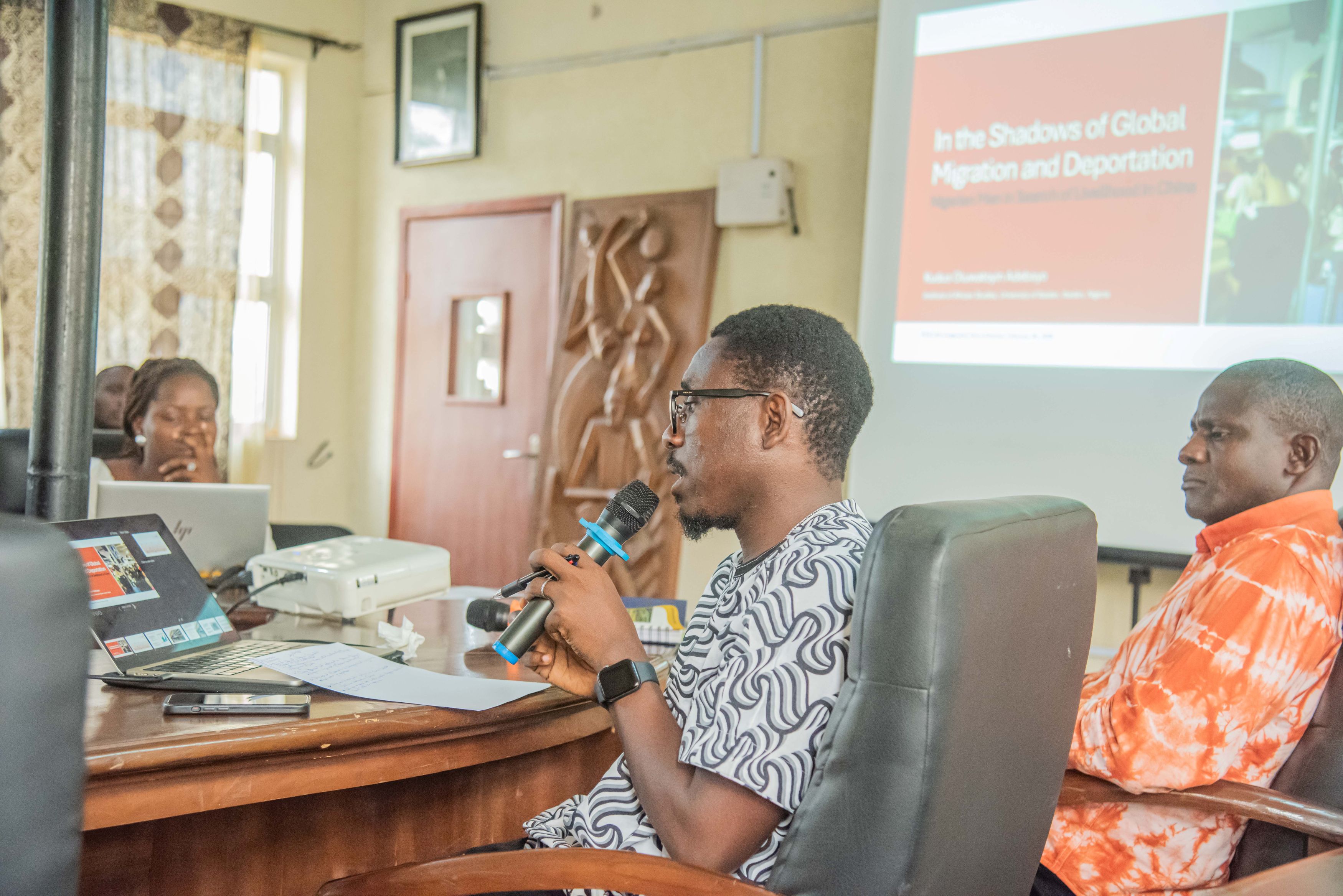
Dr Kudus Adebayo
The first phenomenon he focused on is the term mafan, meaning “troublemaker”. Originating as a market jibe during negotiations, it became heavily tied to Nigerian migrants and leads to tangible impact on access to different services. Indeed, by being associated with this term, the community suffers from discrimination, in particular to find lodging and in their interactions with law enforcement.
To explain this connection, he briefly went back on the history of Nigerian migrations to China, of which we can observe two waves. Starting in the 1990s, many were deported from South Korea or Japan to Hong-Kong, as the territory was, until 1997, part of the Commonwealth. Eventually making their way into other parts of China, these first migrants created important businesses. Exemplifying this is IK Okani who got involved in the motorcycle trade, shipping used vehicles from China to Nigeria. He brought in many Nigerians already in Asia to support his activities. Progressively, representative offices were established to assist Nigerians looking to trade with China.
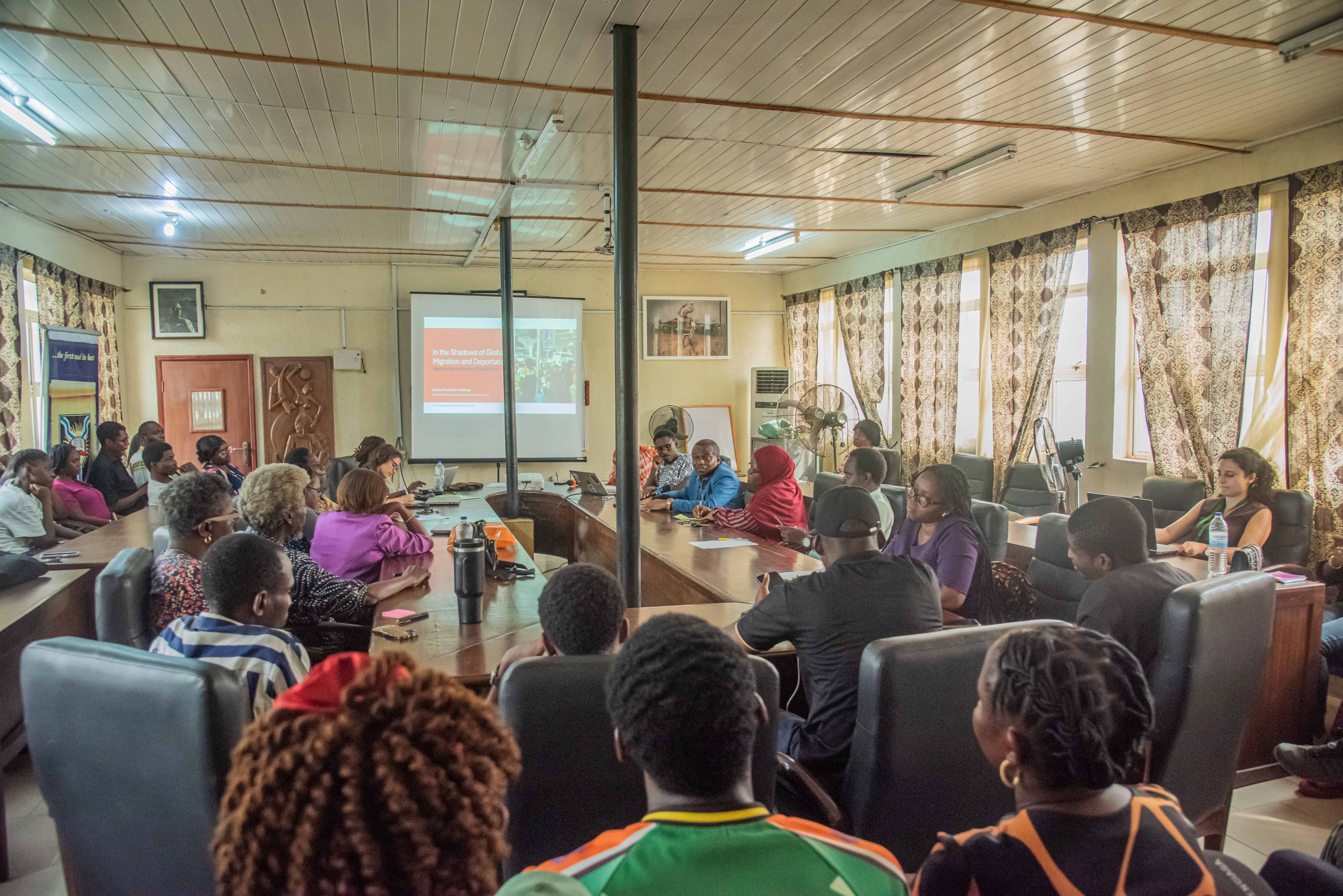
Participants to Dr Adebayo's conference
A second wave of migration came in in the latter half of the 2000s, this time with Nigerians coming directly from their country to China. Dr Adebayo points this moment as the beginning of tensions, as some of the newcomers got involved in drug trafficking and other illegal activities, which strained relations with their host society. He emphasized the importance of remembering that what matters most of all in this shift was the changing perception of Nigerians, more than the actual numbers involved in criminality.
Nigerian communities in China developed instances to mend the situation, including by tracking down members involved in crime themselves, and mediating in favor of Nigerians who stayed past their visa. Despite this, Dr Adebayo explained that the perception of Nigerians as mafan continued to develop, especially following public protests held after the death of a Nigerian man while he was pursued by Chinese police. The negative attitude became increasingly visible in Chinese media and even led other African communities to attempt to separate themselves from Nigerians.
The main consequence of this situation is a key concept in Dr Adebayo’s analysis: “deportability”. The experience of Nigeria in China is marked by the fear of deportation, especially as many overstay, as the short-term visa does not allow them to make a benefit off of their journey. To manage this risk, Dr Adebayo observes a “re-spatialisation” of their presence, as they leave areas where immigration raids took place, in favor of the outskirts of city to more easily evade surveillance.

Dr Kudus Adebayo (left)
On this topic, he noted the importance of running shoes as both innocuous pieces of clothing but also something perceived as essential by the migrants to potentially escape the police. It is a way to navigate deportability. Another way to manage the risks is by information sharing. Through collective WhatsApp groups, the communities organize joint monitoring activities, where people can ask for information on police presence before moving in the city, airport workers inform of potential raids etc.
Dr Adebayo highlighted that deportation doesn’t concern just individuals but is rather a collective experience. Community leaders often visit the police station to negotiate with the authorities, organize fundraising campaigns for their plane tickets or overstay fines and bid them farewell at the airport. He notes that these practices and rituals are done even at great risk for the participants, as many of them are also in a situation of illegality.
During the discussion, Prof. Rasheed Olaniyi offered his own thoughts, comparing the reaction to Nigerian migrants in China to the one in South Africa, wondering about the push factor for migration and more. The conference concluded with a Q&A session with participants.

Professor Rasheed Olaniyi (right)