
On 11 June 2026, Professor Laurent Fourchard (Sciences Po) and Andrew Esiebo, professional photographer and visual artist, presented their collaborative research in our June methodological seminar. In their presentation, entitled “As we see am. A visual ethnography of the National Union of Road Transport Workers (NURTW) in Lagos” they explored what it means to work with an artist as a researcher, including how to manage each different objectives and timelines.
Prof. Fourchard explained that for this particular project, they decided to use sounds and pictures to determine the research question. Indeed, for Andrew Esiebo, a good picture does not only imply technical quality, but should also reveal something about the subject’s life. Mirroring this approach, their presentation took shape around a selection of pictures from their ethnography.
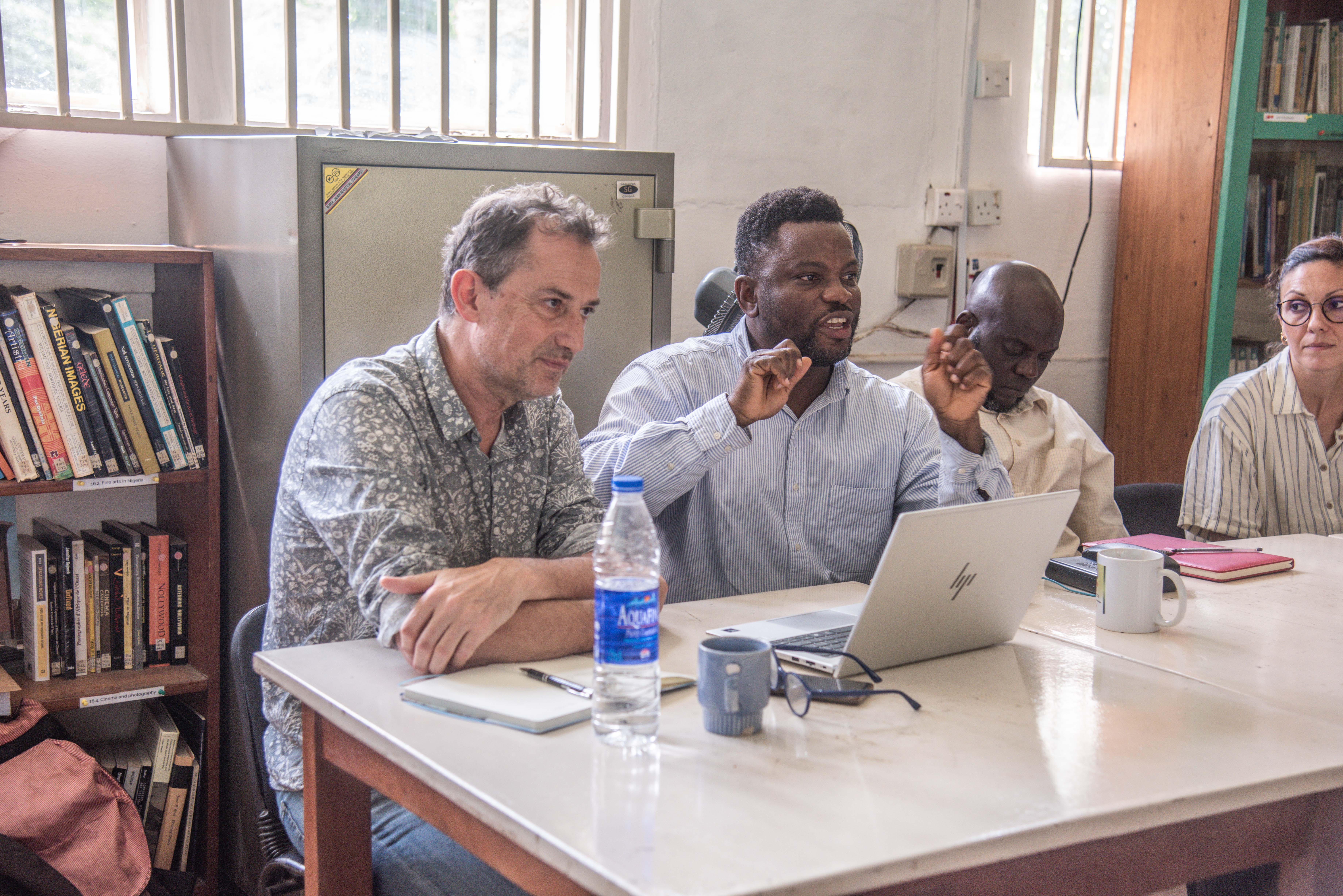
Professor Laurent Fourchard (left) and Andrew Esiebo (right)
The first challenge of their fieldwork was gaining entrance. To study the transport hubs controlled by the NURTW, they first needed a formal authorization from the Secretary of the Union. Moreover, once on site it was also necessary to gain contact with a “gatekeeper” that will allow them to freely interact with the actors.
Their goal was to study the Union from the motorpark level, in particular how daily interactions play out. Photography and videography are integral to the ethnography, to illustrate the daily life of the NURTW members, beyond the political collusion and extortion they are known for.
Dr Fourchard explained how working together meant changing fieldwork practices for him. Where he would usually come to observe in the middle of the day, to capture a better light in photography they conducted their observations early in the morning and in the evening. Thanks to this change in timetable, he was able to observe other aspects of the NURTW’s activities.
Their findings challenge the vision of the NURTW as an inherently violent group, and of the Agberos, those managing the motor parks, as thugs stealing money from the drivers. Taking the example of pictures of the Union members captured during the 1st May celebrations, Andrew Esiebo explained how he used framing and color to illustrate the Union’ strong organizational structure and its hierarchy. His work also shows their sheer number, as the Union is thought to be by certain estimates the largest in Nigeria.
Audience members of the methodological seminar
Agberos, who call themselves ‘parking attendant’, in particular suffer from a very poor reputation, seen at the lowest of the social hierarchy, unkempt and violent. Andrew Esiebo, through his work of portrait, offers a different perspective and integrates elements of their own identity. Prof. Fourchard explained that the agberos collect money from drivers because each day they must give a certain amount back to the Union. They only start to make a profit once they have gone past this amount.
Moreover, Prof. Fourchard noted that extortion via violence is a relatively rare occurrence, that he only witnessed once in his several months of observation. The drivers have integrated the idea that they need to pay a fee, and generally comply. This practice remains nonetheless a taboo, and it is only through months of trust-building that they were able to capture it on camera.
However, they witnessed other forms of physical violence, such as the beating of a thief operating in the motor park. The use of symbolic violence is also common, as Andrew Esiebo described through a series of pictures, in which a Union member was reprimanded by the head of this section, and forced to beg and kneel for forgiveness.
The Nigerian government is complicit in these practices. In charge of managing the carparks, they externalized the collection of taxes to the NURTW already present on-site. As it stands the Union is implicitly recognized by the government, despite its illegal practices. Parallel to this, the Union has its own clear organization, with each driver entering the car park getting a number and their given dues duly collected and noted before they depart. The Union, rather than the government, is also the one to deal with the conflict between the danfo drivers and other forms of public transportation such as okadas and kekes.
Dr Delphine Manetta, IFRA-Nigeria’s Deputy Director, was the discussant for this seminar. The event concluded with a lively Q&A session with the audience.
Participants to Prof. Fourchard and Andrew Esiebo's methodological seminar