
On 6 July, Adam Rodgers Johns, doctoral student in anthropology and Swahili teacher at SOAS University, presented his work “Mapping the impact of regeneration and gentrification on the Yoruba-led religious spaces in south-east London” in our last methodological seminar of the academic year.
His research focuses on the Yoruba community in south-east London, specifically the Peckham area. Often referred to as “Little Lagos,” given the high number of residents from the Nigerian diaspora, it’s also the neighbourhood where Adam Rodgers Johns grew up.
He explained that the area is often described in the last few years as being gentrified. Gentrification describes the process, in urban areas, of wealthier individuals moving in a lower-class neighbourhood, progressively raising the prices of the area and forcing the original inhabitants to move. Often, in the United Kingdom, the people forced to move are also part of a racial minority.
Adam’s project is to map the impact of this process of gentrification. He decided to do this by specifically looking at the locations of Christian worship, first because those are not just religious spaces but also play an important social role in the community. Another reason is their sheer number. Indeed, it is estimated that this area of London has the highest concentration of African Christians outside of Africa, and most of the congregations are Yoruba-led.
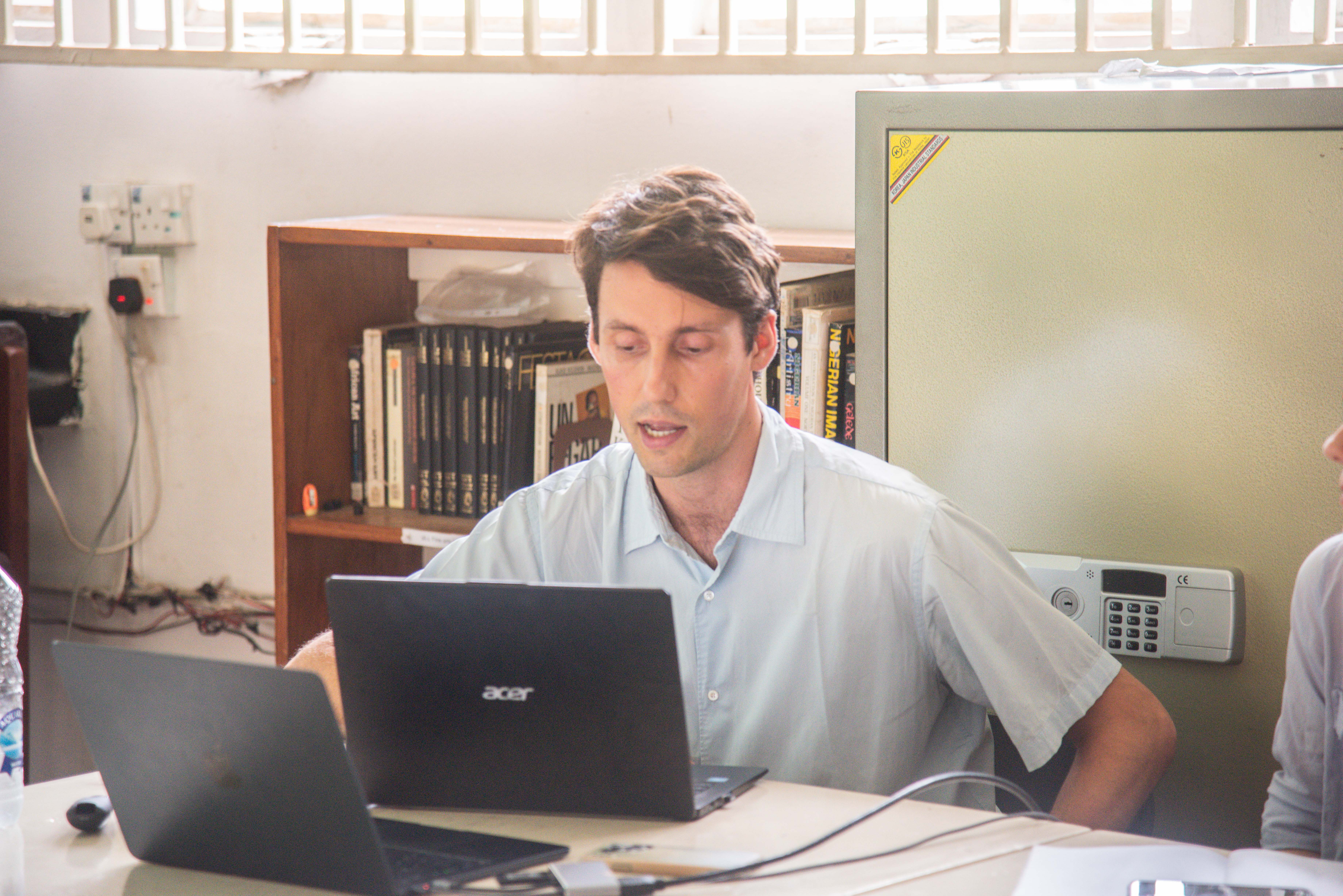
Adam Johns Rodgers
Adam credited photographer Chloe Dewe Matthews for inspiring his research. Specifically, he mentioned her series “Sunday Service”, exhibited at the Tate Modern, in which she explored the expressions of African Christianity in London. To him, her work also highlights a very important contrast: though very visible in the London urban life, these communities are nearly entirely absent from academic scholarship. His own PhD is part of the attempt to change this.
His work explores the everyday realities on how ethnic and national belongings play into gentrification, and pushes back on the simplistic explanation of minorities suffering displacement by white communities. On the contrary, his research puts forward stories of resilience, showing these communities to be not just victims, but also agents.
The throughline of his presentation was the exploration of two case studies: one chapter of the Christ Apostolic Church (CAC) on Rye Lane and another one in Surrey Docks. The Rye Lane chapter is a long-standing one, with a large audience. Though situated in a large space, the entrance – a simple door between two grocery shops – is nearly invisible from the street. Reflecting this, the access to the church is through a narrow hallway, inappropriate for the size of the congregation. In this first case, they do not describe themselves as “integrated” in the local community, but rather define themselves as an “African church in the diaspora.” Their plan is to transform some of the building into housing, in order to profit from the rise in demand in the area. Eventually, they are looking to move their headquarters away from South-East London.
The second case, CAC on Surrey Docks, is in many ways the inverse. Situated in a very visible building, its physical openness is reflected in its philosophy. Though Yoruba-led, they described themselves to Adam Rodgers Johns as a community church, explicitly rejecting the label of “African church.” Hence, they took the decision to hold all services in English, and not in Yoruba. They own the building from which they operate, and have so far rejected all offers made to buy it to build residences in its place.
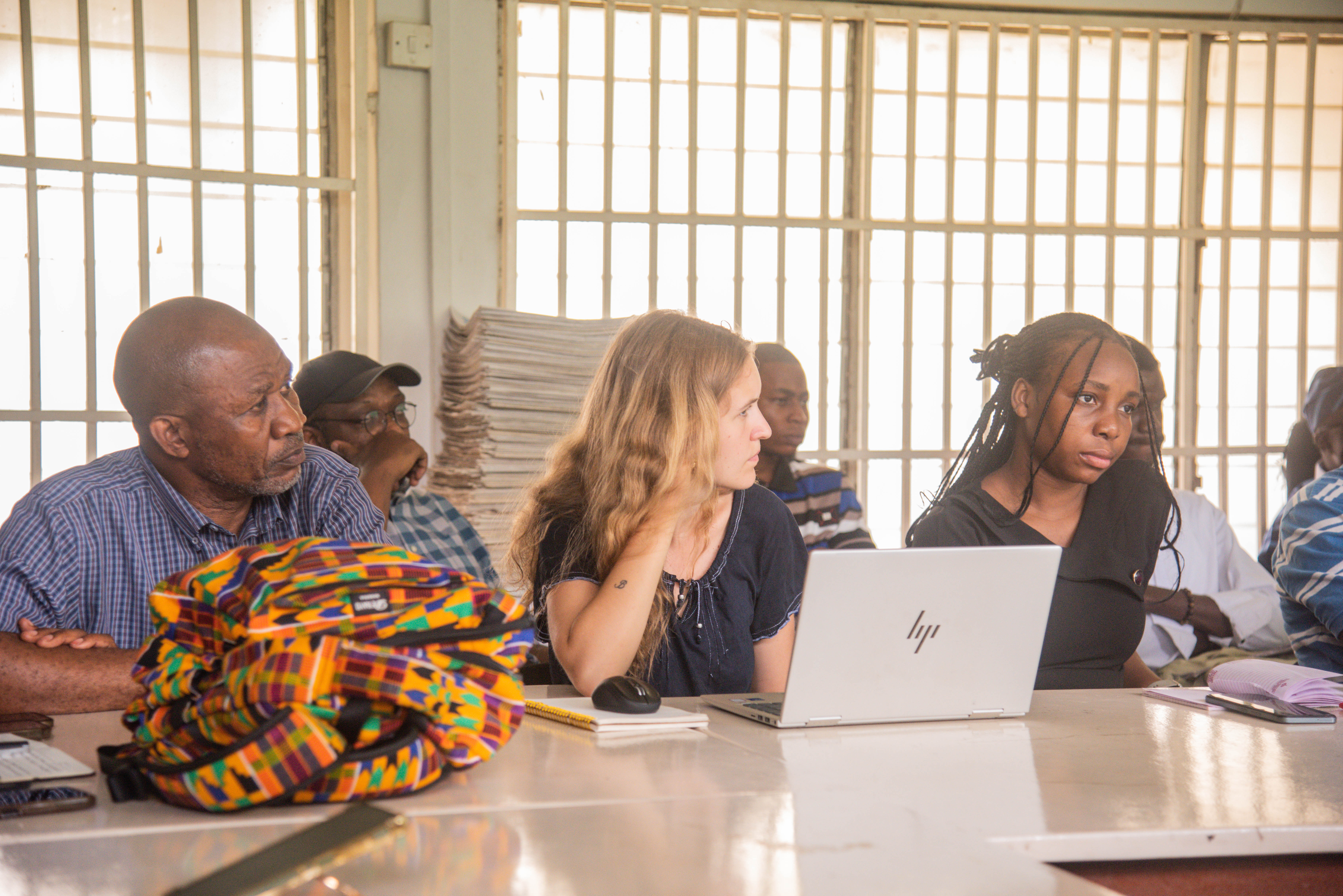
Audience members
In his dissertation he will expand in particular on the question of property ownership, present in those two case studies. He will explore how different models of ownership, freehold, leasehold, etc, influence the congregation’s relationship to a space.
Besides participating in services and observing the religious life of these churches, he also participates in activism organised by those churches against gentrification and its effects. This will allow him to once again show the agency of those communities in this phenomenon.
Adam concluded his presentation by asking for feedback from the audience regarding how to manage his own positionality, how home is negotiated in two different contexts, on his methodological approach especially as he hopes to put in place participatory mapping or to integrate photography.