
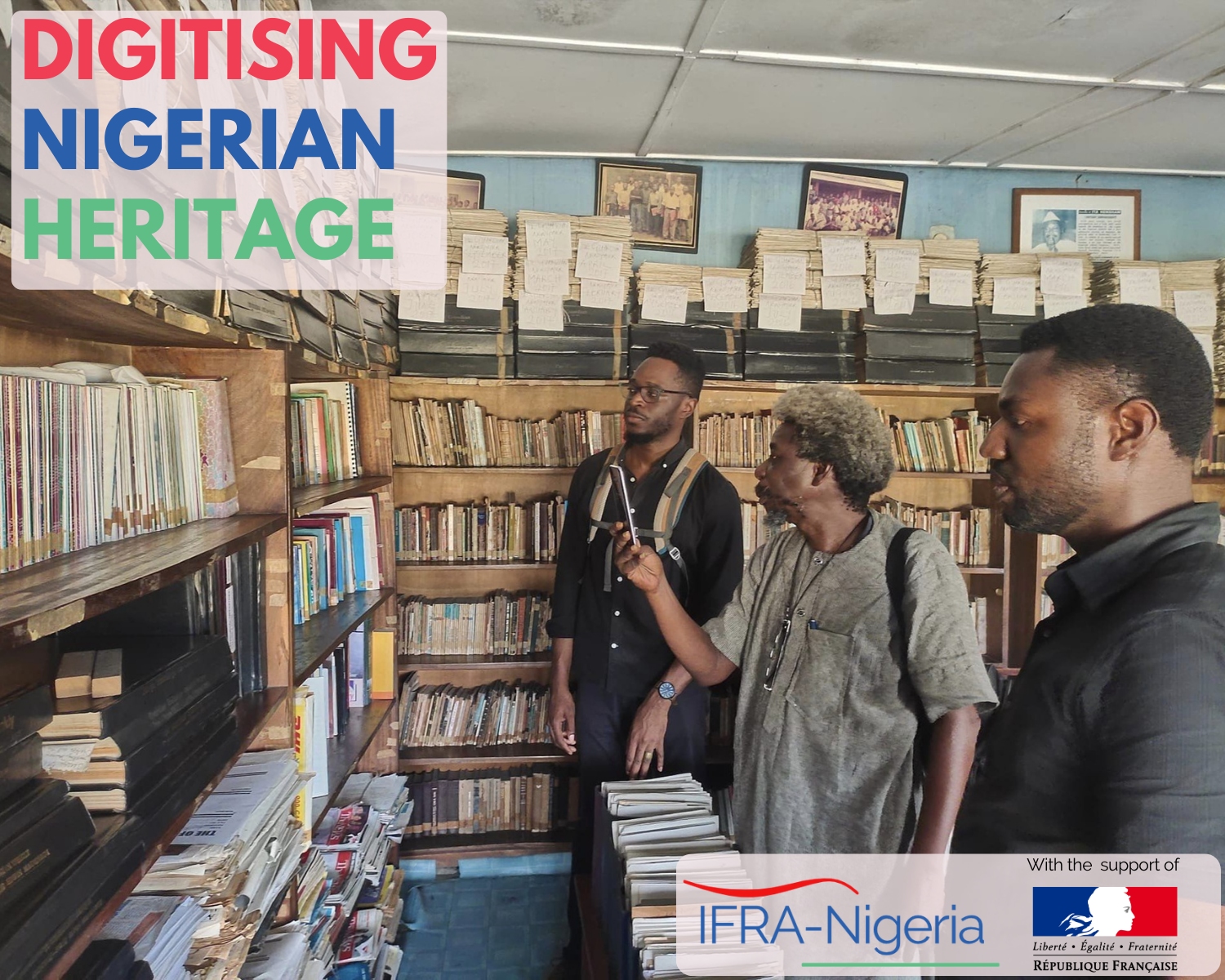
In 2022, the Embassy of France in Nigeria and IFRA-Nigeria have been awarded funding to support efforts by Nigerian researchers and professionals, from partnered institutions, to develop their ideas and projects on the conservation of Nigerian Heritage and Patrimony.
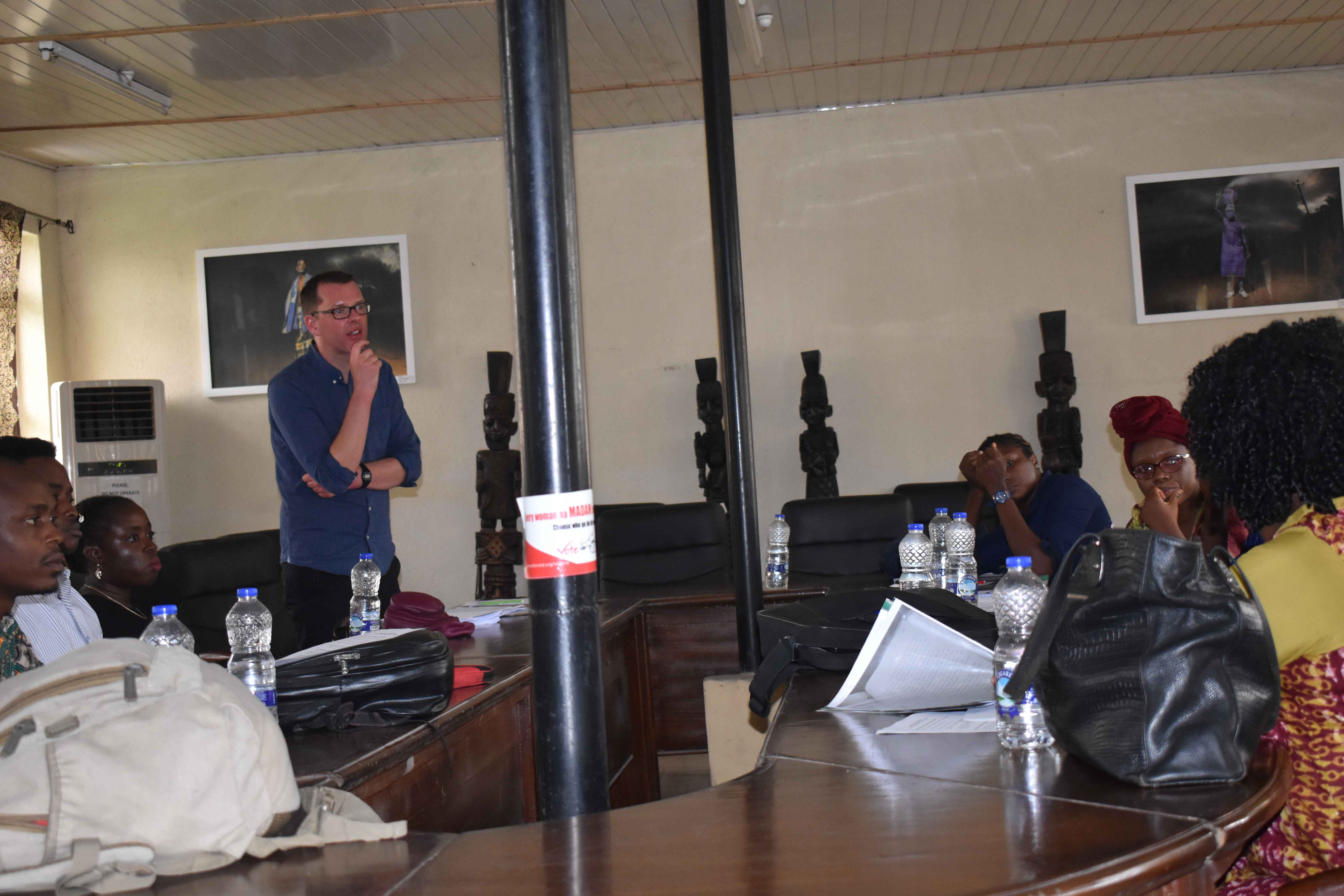
From left to right: Dr. Sa'eed Husaini, researcher at the Centre for Democracy and Development (CDD), Dr. Sola Olorunyomi, associate professor at the University of Ibadan,
In 2022, the Embassy of France in Nigeria and IFRA-Nigeria have been awarded funding to support efforts by Nigerian researchers and professionals, from partnered institutions, to develop their ideas and projects on the conservation of Nigerian Heritage and Patrimony.
The objective of this project is to put digital technologies, as well as French and Nigerian expertise, at the service of the protection, enhancement, and dissemination of Nigerian heritage processes to different local and global communities. In practice, it is a response to the growing challenges in the world of research of Nigerian cultural and heritage studies with the objective to improve the protection, conservation, dissemination, and training about heritage and develop sustainable capacity in this area.
The Solidarity Fund for Innovative Projects (FSPI) is a program run by the French Ministry of Europe and Foreign Affairs designed to help French institutions abroad carry out research-action activities in the country where they work, in close collaboration with local stakeholders.
In this FSPI project, IFRA-Nigeria will be working with Nigerian partners to
1) Select processes of Nigerian cultural heritage and their conservation,
2) make these heritages more accessible to a wider audience with the help of digital tools,
3) provide training opportunities for a new generations of Nigerian researchers,
with a specific focus on the gender and age of the researcher. At the beginning, the project is made up of five different component projects but with dynamic connectivity in the core objectives of the broader FSPI project.
Objectives of the FSPI project:
- Structuring Franco-Nigerian relations in the sectors of protection, promotion, and dissemination of Nigerian heritage processes.
- Building a fair partnership and collaboration models aimed at co-constructing projects and jointly mobilising French and Nigerian expertise to develop skills.
- Demonstrating the relevance of such an approach through the implementation of projects that are eventually replicable and provide deliverable added value in the medium term.
Five components of the project
- Protecting political activists’ archives to write another history of Nigeria
- Partners: Centre for Democracy and Development (CDD), Abuja & Socialist Library and Archives (SOLAR), Calabar. Coordination: Dr. Sa’eed Husaini (CDD).
Objectives:
- Create an inventory and digitise pre-selected archives of professors Bene and Edwin Madunagu in Calabar as well as other activists’ archives.
- Academics and activists will be sponsored to publish research on the digitised archives (as well as the papers of professors? Ola and Kehinde Oni previously digitised by IFRA-Nigeria). Workshops will be organised to disseminate knowledge about the digitised archives.
- Digitising and promoting the documentary collections of the National Museum of Lagos
- Partners: National Commission for Museums and Monuments (Lagos National Museum) & African Artists’ Foundation, Lagos. Coordination: Pedro Taye
Objectives:
- Digitizing and promoting the documentary collections of the National Museum of Lagos, especially the maps and papers of the Museum’s founder Kenneth Murray.
- Training of staff and other heritage specialists.
- Researchers will be hired to work on the digitised collections.
- Partnership with the African Artists’ Foundation to have artists working on and interrogating the digitised collections.
- Final exhibition and event with the artists and researchers.
- Creating a digital archive of the intangible heritage of Benin (Nigeria)
- Partner: Institute for Benin Studies, Benin City
Objectives:
- Creating a digital archive of the intangible heritage of Benin (Nigeria)
- A group of young researchers specializing in Benin Studies will be trained in sound and video recording and the challenges of digitizing intangible heritage during a five-day masterclass at the start of the project
- Elements of Edo’s intangible heritage (songs, ceremonies, rituals) will be collected, annotated, translated, and archived on a dedicated website
- A high-level event will be organized in Benin City and broadcast online to present the digital archive
- Promoting the religious architectural heritage of Ibadan
- Partners: Institute of African Studies & University of Ibadan & others. Coordination: Cell Generation Technology (CGT) & Dr. Cyrielle Maingraud-Martinaud (IFRA-Nigeria)
Objectives:
- Organisation of workshops on the religious architectural heritage of Ibadan
- Digitisation of selected religious buildings
- Training of Nigerian researchers in techniques for digitising religious architectural heritage
- Creation of an interactive digital map of notable places of worship in Ibadan
- Protecting the urban archaeological heritage of Ile-Ife
- Partner: Epot Integrated Concept & Museum of Natural History, Ile Ife.
Objectives:
- Mapping historical pavements of Ile-Ife.
- Training in the preservation of archaeological heritage
- Raising public awareness of the protection of urban archaeological heritage
- Creating interest through open access of the digitised heritage of Ife
- Partnership for the creation of a center of interpretation on one of the sites

- 2018/2023
Discover the project
Remoboko is a study of religiosity and how it affects secular education (boko, in Hausa) in West Africa. It focuses on the presence, competition and conflict between secularism, Salafism and Pentecostalism on two campuses (Université Abdou Moumouni, Niamey, Niger, and University of Ibadan, Ibadan, Nigeria). It examines how students that seek a degree that would insure them a better life, resort to Salafism and Pentecostalism. How boko in this context is both appealing and rejected is at the core of the project.
In Niger and Nigeria, the two countries the project covers, boko is criticized for being morally corruptive, culturally alienating and socially unfit because it supposedly lacks grounding in religious norms. In targeting secular schools in both countries, the terror organization Boko Haram has illustrated the problematic nature of boko and the dark side its appropriations may have. Across Africa, Salafis and Pentecostals have targeted learning institutions. These religious groups criticize these institutions for practices and values they deem inauthentic and dangerous. In that process, as one may notice on campuses across West Africa, students have become religious actors in their own right, challenging and redefining conceptions of good life and being a student.

- 2019/2022
The research programme PADIR, establish at IFRA-Nigeria in 2019, aims at analyzing the field of institutional inter-religious dialogue in Africa from a critical perspective, with Nigeria and Tanzania as case studies.
Discover the project
Inter-religious organisations, forums and projects have flourished at the global level since the beginning of the 2000s, especially after the 9/11 attacks. They differ from the ecumenical dialogue initiated by the Catholic Church after the Second Vatican Council as they are based less on theological discussions than on the idea that religious leaders are key actors in the solving of economic, social and political problems, especially linked to poverty, extremism and terrorism. Mobilizing the language of « peace building », many initiatives have been launched by religious organisations, NGOs as well as States and regional bodies as part of their diplomatic action.
With their population roughly divided between Christians and Muslims, both Nigeria and Tanzania have been considered important « laboratories » for inter religious dialogue in Africa. Perceived as being marred with conflicts and in a perpetual state of « crisis », Nigeria is also identified at a frontline of the global fight against terrorism and religious extremism. On the other side of the spectrum, Tanzania is seen as a stable country, a « heaven of peace » and example of religious coexistence, though under multiple threat linked to international Islamist networks, sporadic ethnic violence or separatism.
In both these cases, international involvement in the national fields of inter-religious dialogue has met endogenous dynamics. In Nigeria, several initiatives had been launched since the mid 1990s, with a new vigor since the return to democracy in 1999. Both at the federal and at the States' level, inter-religious forums and organisations have been created, often supported by local « big men » and politicians competing for votes and influence. In Tanzania, the rhetoric of « peace and stability » and the development of local inter-religious dialogue forum has been parallel to the growing involvement of religious leaders in the political sphere, in the context of the perpetuation of a dominant party system and authoritarian politics despite the return to multipartism in 1992.
The objective of PADIR is to identify the actors, organisations and networks that have contributed to the emergence of the field of inter-religious dialogue and its functioning, both from a local, national and transnational perspective. Through the case studies of Nigeria and Tanzania, it intends to understand better inter-religious relations, the dynamics of both Christian and Islamic religious fields, as well as the complex relationships between religious and political actors.
Methodology
This project will combine several qualitative methods including semi-structured interviews with national and international actors of the inter-religious dialogue field in Nigeria and Tanzania ; biographical interviews with key religious figures involved ; observation of projects and initiatives on inter-religious dialogue ; social network analysis.
The comparison between two contrasted cases will highlight the similarities and differences between the Nigerian and Tanzanian approaches to inter-religious dialogue as well as the factors explaining these variations.
Two workshops will be organized in Dar es Salaam and Ibadan in 2020 and publications are expected in 2021.
Coordinator
Dr Cyrielle Maingraud Martinaud
Research Associates
Abimbola Omopo (Institute of African Studies / UI)

- 2019/2022
The TNOC West Africa project investigates local narratives of drug and people smuggling in Nigeria and Niger.
Discover the project
Summary:
Over the last fifteen years, West Africa's role in illicit flows, i.e. the illicit trade in goods and people, and their control has become a central concern for international and domestic policy makers, with attention coalescing around threats such as drug trafficking and irregular migration. Despite this growing policy interest, illicit flows and related transnational organised crime (TNOC) in the region have not yet been systematically studied.
Our project asks whether crime of a transnational and organised form exists in West Africa, and investigates the understandings of it held by people acting on different sides of the law. The project assumes that the ways criminal and state actors speak about and understand their roles, i.e. their 'narratives', provides a helpful entry point into a better understanding of the everyday reality of participating in and seeking to counter criminal activities. The project is built on the observation that much of our understanding of TNOC in West Africa is based on official reports, statistics and other largely detached assessments about this phenomenon. Using the cases of drug trafficking and people smuggling in two of West Africa’s major trade and control hubs (Lagos, Nigeria and Agadez, Niger), the project seeks to uncover the 'hidden narratives' of TNOC in order to better understand the practices around TNOC in West Africa. The project asks three overarching research questions: (1) Is there such as thing as TNOC in West Africa? (2) What are the local narratives on TNOC and related visions of 'il/licitness’ and legitimacy? And finally, (3) how useful are our conceptual tools for understanding TNOC in this regional context?

- 2017/2021
 NaijaSynCor Research Project
Discover the project
NaijaSynCor (A Corpus-based Macro-Syntactic Study of Naija, aka Nigerian Pidgin) takes an exhaustive and in-depth look at the structure of Naija (Nigerian Pidgin) in Nigeria today. Spoken by educated Nigerians, it has been proved to develop in Lagos as a discrete language, separate from Nigerian English. This study proposes to assess whether this holds true for the rest of Nigeria where Naija is spoken by over 75 million speakers. It examines diachronic, diatopic, diaphasic, diastratic, and genre variation.
The project is a collaborative effort of two Nigerian leading experts on Naija (F. Egbokhare & C. Ofulue) and two research units that have proved their expertise in corpus annotation in previous programmes: Llacan, on lesser-described languages; Modyco, on the interaction of prosody and syntax in French and the development of large treebanks, and. The macrosyntactic framework developed in the ANR Rhapsodie project (Lacheret, Pietrandrea & Tchobanov 2014) has proved to be particularly efficient in dealing with the specificities of oral corpora, e.g. piles stacking, disfluencies, repetitions, discourse markers, overlaps, co-enunciation, false starts, self-repairs and truncations. This method is data-driven, inductive (the relevant units are identified through annotation) and modular.

- 2020/2021
This research programme established at IFRA-Nigeria in 2020, aims at, first, gathering data on the consequences of the global pandemic in Nigeria and, then, analyzing the impact of the crisis at different levels. Click here to access the data collected and the outputs of the projet.
Discover the project
The emergence of Covid-19 late 2019, and its subsequent spread all over the globe, have challenged both stable and fragile States, have endangered even the strongest economies and transformed all societies. In Nigeria, the virus has, very early on, been considered as a serious threat and the governments, State administrations and civil society actors warned citizens and put in place measures to avoid its spreading.
This unprecedented situation demands a fine analysis based on human and social sciences. As early as May 2020, IFRA-Nigeria launched an interdisciplinary research programme in order to understand the impact of the pandemic in Nigeria at different levels.
The programme fosters research projects conducted by young Nigerian researchers addressing various consequences of the pandemic. In line with both IFRA’s research priorities as well as the proposals submitted, two main themes have been favored:
- Religion and Covid-19 in Nigeria
- Economic impact of Covid-19 in Nigeria

- 2019/2020

In 2018, the Tony Elumelu Foundation (TEF), the French Development Agency (AFD) and the French Institute for Research in Africa, Nigeria (IFRA-Nigeria) signed a partnership agreement that included a knowledge production component. It was decided that this would consist in an academic research work.
The primary objective of this research collaboration is to assess the economic and social impact of the TEF entrepreneurship programme in four African countries. This research partnership shall allow for taking a deeper dive into a selection of businesses established or developed with the support of TEEP and an assessment of their effects within particular areas and communities.
The research aims to shed light on some of the following issues: (1) the economic and social impact of TEF entrepreneurs in their host communities, (2) additional funding received by entrepreneurs upon programme completion, (3) the ease of doing business in their respective countries, (4) the impact of their businesses within rural communities and (5) the capacity of TEF entrepreneurs to achieve or help achieve the Sustainable Development Goals of the United Nations (SDGs).
The following countries are of importance to TEF due to their thriving entrepreneurial ecosystem and also because they account for the highest number of TEF entrepreneurs in Anglophone and Francophone Africa:
- Nigeria (1969)
- Kenya (385)
- Cameroun (106)
- Côte d’Ivoire (68)
Two junior researchers were selected by IFRA-Nigeria to work on the project:
- Terhemen Agabo, a Master’s student in Economics from the University of Ibadan (Nigeria)
- Luc-Yaovi Kouassi, a Master’s student in Political Sciences at the Panthéon Sorbonne Paris 1 University (France)
They were hosted within IFRA permises in Ibadan to prepare the fieldwork and analyse the data. Their work was supervised and coordinated all along by IFRA’s research associate, Clémentine Chazal and IFRA’s Director, Dr. Elodie Apard.
The Tony Elumelu Foundation (TEF) provided a database of entrepreneurs as well as other logistical support for the work.
- 2014/2020
Discover the project
TransIslam is a two-year research program (2014–15) initiated by IFRA-Nigeria, funded by CSFRS, and led by a team of seven researchers from Niger, Nigeria, France and the UK.

- 2016/2019

Discover the project
The research program TREEBADAN/IGI’BADAN “Local Knowledges and Relations to Remarkable Trees in Ibadan (Oyo State, Nigeria)”, aims at establishing an assessment of the natural heritage of the city of Ibadan (Oyo State, Nigeria), from a botanical, but also a historical and an anthropological perspectives.
The Treebadan project is now part of the ANR-funded 4 year research programme INFRAPATRI Knowledges and attachments to urban plants in Sub-Saharan Africa (Benin, Cameroon, Nigeria, Senegal): identification and production of a heritage from below. You can find more information about this ANR in french or in english.
This will involve drawing up an inventory of the trees within the city seen as “remarkable” according to their botanical characteristics (Modelled on the inventory realised by the cities of Paris or New York for instance), but also as supports of the urban memory and identities, markers of specific historical events (rituals, judgments, political or festive gatherings, battles, markets, etc.), places and objects of sociability and urbanity (places of meeting, worship or trade, elements of the local pharmacopeia, objects of ornamentation and attachment, etc.) and tools for urban governance. One of the objectives of the project is also to evaluate the effective tree biodiversity of Ibadan and how it is perceived and used by Ibadan citizens, through an ethnoscientific approach.
More broadly, TREEBADAN aims at deciphering what the relationships of Ibadan’s city-dwellers and authorities to urban trees and nature tell us about:
- the urbanistic history of the city
- the construction of an urban memory and the definition of urban social and cultural identities, modes of sociability and of “living-together” in the public spaces of the city
- the governance of the city, captured through its management of natural elements over the years
To that end, the research is conducted by a multidisciplinary team of researchers, in social sciences, humanities, urban studies and natural sciences, from France and Nigeria. The scientific team partners also with artists to capture local relations to urban trees through a more aesthetic and poetic apprehension, and to disseminate the results of the program to a wider audience. Finally, TREEBADAN results could lead to a practical programme aiming at recognising the urban remarkable trees as part of the natural, but also cultural heritages of Ibadan, and from that at protecting them, so to as to fight against deforestation and to preserve urban biodiversity, starting from local knowledge and relations to urban nature.

A kola tree in front of a photo studio at night, Irefin, Ibadan, S. Chevalme
Methodology
The program is directed by Dr Emilie Guitard, anthropologist and researcher at IFRA-Nigeria. Together with Adedeji Adebayo, PhD student from the University of Ibadan, they have started since 2017 to conduct ethnographic fieldwork by realising open interviews with citizens living close to the trees and/or interacting with them on a daily basis, along with the relevant municipal authorities, and by realising sessions of participant observation to understand the interactions between these different actors in social, economic, political or religious terms with and around the urban trees. Dr Guitard and A. Adebayo are also carrying ethnoscientific data collection to evaluate the local knowledge and uses regarding general and urban tree biodiversity.
As a second step, Dr Guitard will partner with Dr Saheed Aderinto, associate professor of History at Western Carolina University (USA), to redraw the history of the management of the urban natural elements, notably trees, by the successive authorities of Ibadan. A geographer or an urban-planner will also be associated to the program to study the spatial repartition of trees in the city, according to their species and uses, but also in line with the history of their public management. Within this frame, the trees identified as remarkable will be geo-located, to produce a digital map of urban trees in Ibadan, including not only botanical, but also anthropological and historical data. Finally, a botanist will be associated to TREEBADAN to assess the tree biodiversity of Ibadan and proceed to the botanical identification and dendrochronological dating of the urban trees said to be “remarkable” by the city-dwellers.
At last, to capture the local relations to urban nature through an aesthetic and poetic apprehension, and notably to describe the urban atmosphere under the urban trees and its variation depending on the neighbourhood, the time of the day or the type of activities going on there, the scientific team is collaborating with French and Nigerian visual artists, photographers and documentary film maker. In October 2017, the French graphic designers and visual artists Elodie and Delphine Chevalme (better known as Les Soeurs Chevalme) spent two weeks doing fieldwork with Dr Guitard and A. Adebayo to realise drawings and pictures around “remarkable” trees in the historical centre of Ibadan. These artistic productions will be presented to the general audience of Ibadan, Nigeria and abroad through various mediums, including a multimedia exhibition and a coffee table book, together with brief texts by the members of the scientific team. As a second step, the scientific team will also partner with the French and Congolese documentary film maker Alain Kassanda, to realise a poetic documentary on the relations of the inhabitants of Ibadan to urban trees.

A garage under an Almond tree, Ita Baale, Ibadan, E. Chevalme
Finally, the results of TREEBADAN could be used to nurture applied programs to fight locally against deforestation by preserving the urban biodiversity. The trees listed as remarkable will be presented to Ibadan and Oyo State authorities to be patrimonalized and protected, as part of the city heritage. The data produced within the frame of the program could also be mobilised to realize a botanical walk throughout the city, presenting by means of panels the main information concerning the most remarkable trees in the different registers studied (botany, history, anthropology). Commented tours of this walk could also be organised in collaboration with the researchers and the inhabitants interviewed for the city schools, together with the screening of the documentary and possibly the presentation of the multimedia exhibition. TREEBADAN/IGI’BADAN will in this context serve as a tool to raise awareness on the wealth of Ibadan’s trees as part of its natural and cultural heritages, and on the necessity to preserve them, starting from the local knowledge and relations to them.

A Fig tree in front of the Ogunmola compound, Bere, Ibadan, D. Chevalme
Team Members
Academic team
- Dr. Emilie Guitard, Scientific coordinator of the project (IFRA Nigeria, France/Nigeria)
- Dr. Saheed Aderinto, Historian (Western Carolina University, USA)
- Adedeji Adebayo, Research assistant (PhD student, University of Ibadan, Nigeria)
Artistic team
- Elodie and Delphine Chevalme aka « Les soeur Chevalmes » (visual artists and graphic designers, France)
- Alain Kassanda (documentary film maker, France/DRCongo)
Associated events

Presentation (in French) of the program and its first results by Dr Guitard during a round-table on “Nature, art, ville”, organised by Dr A. Choplin (Global Studies Institute, Geneva) for the Institute for Research for Development (IRD) at the Institut Français du Bénin, Cotonou, December 2017

Presentation (in French) of the program and its first results by Dr Guitard during a round-table on “Patrimoine dans les villes d’Afrique: les cas de Yaoundé et d’Ibadan”, organised by Dr M. Morelle (University Paris 1/CNRS) and the Fondation Paul Ango-Ela at the Institut Français du Cameroun, Yaoundé, June 2018

Presentation (in French) of the program and its firt results by Dr Guitard within the Labex DynamiTe workshop on “Perceptions des changements par la biodiversité ordinaire. Savoirs locaux sur la biodiversité et les changements globaux en milieux urbains et périurbains”, organised by Dr A. Sourdril (Ladyss, Nanterre) and Prof. C. Raimond (Prodig, Paris), University Paris Diderot, March 2019

- 2017/2019
Discover the project
The general objective of the project is that rights of migrants are promoted and respected and migrants are protected from trafficking in human beings. The specific objective aims at preventing and eradicating human rights violations against migrants and asylum seekers, especially children and women coming from Nigeria, and at risk of victims of trafficking in human beings. The project aims at supporting the implementation of the Palerme protocol (2000) and led by the French NGO ECPAT France.
The vulnerability of prospective victims is commonly due to prevalent poverty, high rate of unemployment, cultural norms that deprive children and girls a say in decision affecting them and ignorance. As a result, victims are easily deceived by agents who go around convincing girls and parents about the huge prospects of making it abroad. NGOs and journalists are reporting the increasing number of children (girls) and women migrating from Nigeria to Europe and coming from rural areas of Nigeria. They arrive in Italy by boat after a long trip through Nigeria, Niger and Lybia. They report the trauma of witnessing the death of travel mates. When they arrive, most of them, are already victims of a criminal network who will sexually exploit them in Europe and use elaborated coercive strategies to keep them under exploitation. Reality begins to dawn on the girls when they are being subjected to forced rituals and oaths.
Increased knowledge and awareness on the situation of children and women migrating from Nigerian to Europe will result in better prevention of trafficking situations, better protection during transit and lower risks of persecution in case of return. The action will therefore take place in Nigeria (Edo Central), a departure point for the migration route to Europe.
Method
- Methodologies
The project Packing is an interdisciplinary project which encompasses 5 Nigerian researchers: two historian, one anthropologist, one criminologist and one philosopher. The team of Nigerian researchers have all conducted long (minimum three months) fieldworks in Edo State. The overall objective of the project is to cross empirical data collected in Nigeria by the Nigerian research team with data collected in France by French and Nigerian, notably through the French NGO les amis du bus des femmes.
The Nigerian team of researchers are mostly from Edo State, speak Edo language and are familiar with the historical, cultural and social context in which the emerged the observed phenomena. They are also specialists of the issues of human trafficking for sexual exploitation in Nigerian and have led for several years their own research on the topic.
- Schedule
Duration: 2 years January 2017 to March 2019
Team members
Scientific coordinator for the Nigerian research team: Dr. Elodie Apard, director of IFRA-Nigeria
Publications (E-papers)
Associated events
- Conference for the restitution of the research project PACKING, March 7, 2019 at Paris City Hall, France
Partners
PACKING Project is co-funded by the European Instrument for Democracy and Human Rights (EIDHR) of the European Union and is coordinated by the NGO ECPAT France.
ECPACT France: http://ecpat-france.fr/
Les amis du bus des femmes (France):


- 2014/2018
Discover the project
GlobAfrica is a four-year Research programme funded by the French National Research Agency (ANR) that aims to rethink the global integration of Africa before the European Imperialism from a historical perspective.